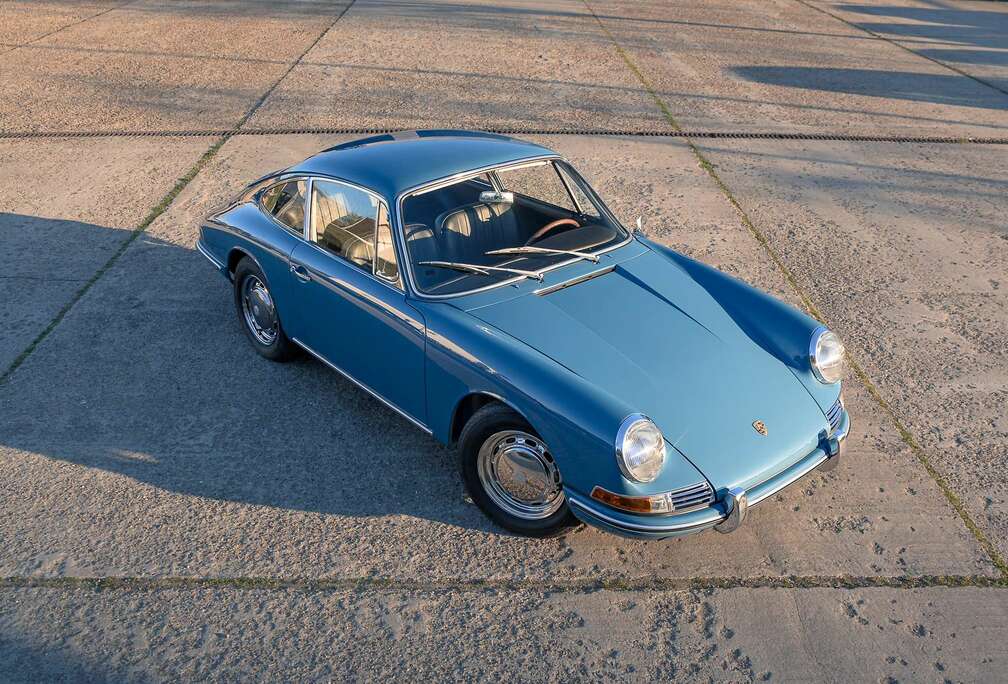
- One of the first 232 Porsche 911s ever built
- Fully matching and concours-restored
- Delivered to Sonauto Paris
Once upon a time… there was a number: 901. It was September 14th, 1964. In a quiet corner of Stuttgart-Zuffenhausen, a handful of engineers rolled the very first Porsche 901s off the line. No ribbon-cutting, no fanfare, no champagnejust the soft clatter of tools and the focused silence of history being made. Nobody knew it then, but they weren’t just assembling a sports car. They were igniting a legacy.
What began as a modest experiment in six-cylinder sophistication would go on to become the blueprint for every Porsche that followed. The 911 wasn’t born with a roarit whispered its arrival. And then came a phone call from France. Peugeot, ever so charming, rang up with a polite legal objection: they had trademarked every three-digit model number with a zero in the middle. Yes, really. So Ferry Porsche, in a masterstroke of German pragmatism, simply swapped the zero for a one. Problem solved. Brochures saved. Badges preserved. And unintentionally? The most iconic name in sports car history was born.
This carchassis 300082is not just part of that story. It is the story. Built on November 12th, 1964, it’s one of only 232 cars completed before Christmas of that year. In Porsche terms, this isn’t early. This is Genesis. Delivered to Sonauto in Paris on December 19th, 1964, it holds a special place in the Early 911 Registry (with thanks to Robert Fleming of Minnesota). Originally assigned engine number 900193, it received engine 900192 just before deliverya subtle switch recorded by hand in Porsche’s original ledger, and still present in the car today. A ledgers-don’t-lie kind of car. Now under Belgian ownership, this 911 has been treated to a full nut-and-bolt restoration by marque experts. Every screw, seam, and surface was meticulously brought back to exacting, period-correct standards. Its original color, Enamel Bluea deep, elegant hue confirmed by its Kardexwas reapplied with the care of a conservator restoring a museum piece. The cabin, trimmed in authentic black leatherette over charcoal carpeting, features all the rare early-production details: top-mounted dash screws, aluminum steering wheel frame, and steel wheels date-stamped 11-64’. Nothing here is imitation. It’s all real. And cruciallyit’s not just a static sculpture. This 911 runs. Many early examples like this exist only as restoration projects. Not this one. With its 2.0-liter flat-six making 130 horsepower, it doesn’t ask you to dominateit asks you to dance. Weighing just over a metric ton, it begs to be revved. Keep it above 4,000 rpm, and that modest flat-six transforms. Suddenly, what felt civil becomes spirited. The engine rasps and soars to 6,200 rpm with a metallic symphony that will send shivers down the spine of any true enthusiast.
The handling? Unfiltered. These early 911s had a wheelbase 57mm shorter than post-1968 models. That, combined with the featherlight front end and complete absence of power steering, gives you a purity of feedback that modern cars can only dream of. It’s not just drivingit’s communion.
This very chassis appeared at the 2018 Zoute Concours d’Elegance, where it drew admiration not just for its condition, but for what it represents: Porsche’s very first attempt at what would become a half-century-long masterpiece in motion. Its provenance is secure, its restoration exceptional, and its name already etched in the official Porsche Register. Owning this car isn’t about nostalgia. It’s about legacy. It’s the first heartbeat of a living legendAnd it could be parked in your collection. Now available at Rock ’n Roll Classics.
Les informations fournies le sont dans la ou les langue(s) choisie(s) par le vendeur